
Writing Lessons from an Alien
I watched all of the movies.

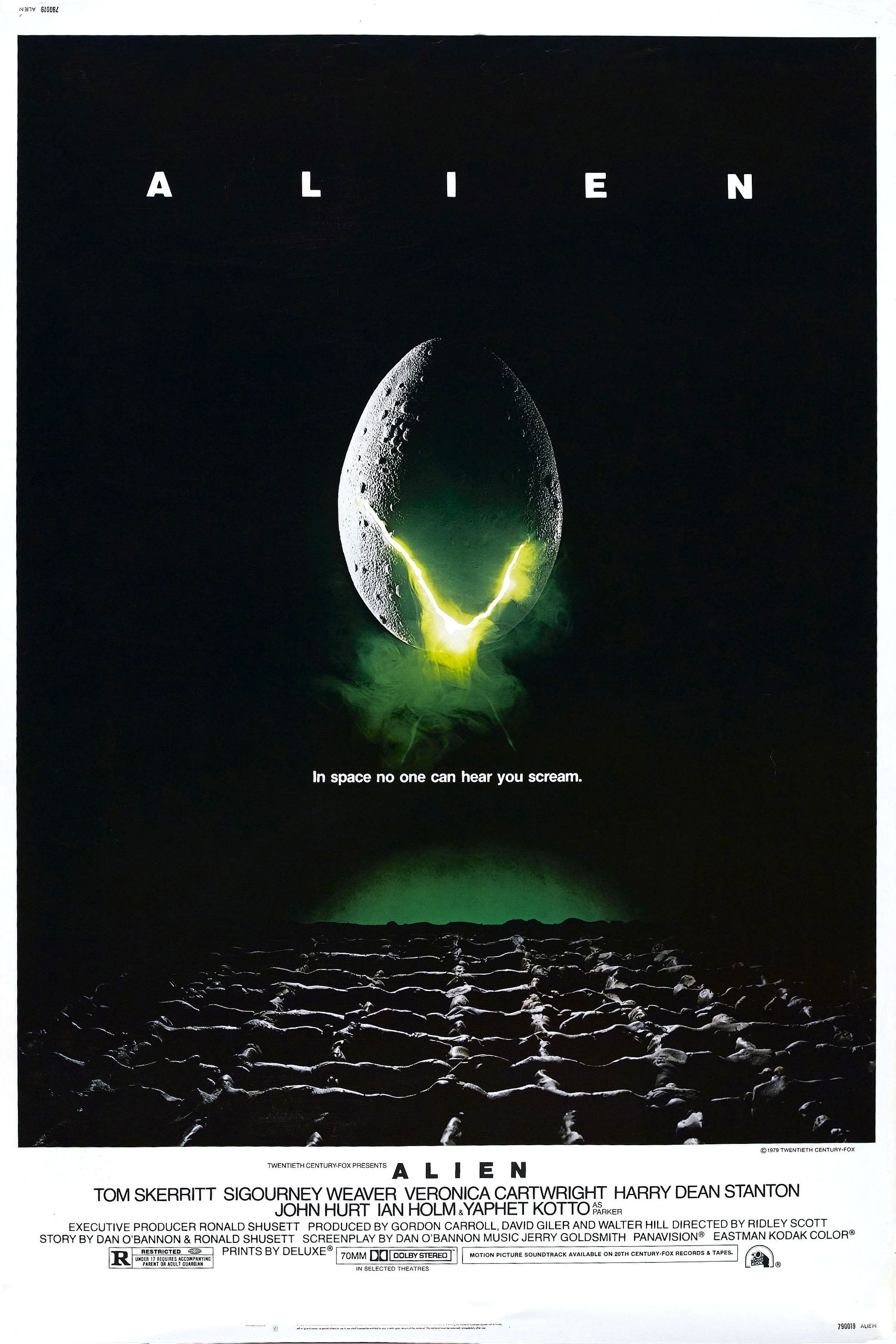
We’re into November now, so this is a little late, but I saw every movie from the Alien franchise over the last couple of weeks. I wanted to watch some spooky stuff without getting into the slasher/demonic side of the horror genre, and the usual suspects (Hocus Pocus, Goosebumps, etc) don’t always scratch the itch. I’d never seen these movies all the way through.
Now that I have, I’ve learned some do’s and don’ts. Some of this will carry over to novel writing, and some of it is just a casualty of an IP that started out as a sci-fi horror flick, garnered a fandom, and then went on to hop a few studios where it was handled by eight directors and fourteen writers.
There’s probably no intellectual property that could come out tidily after that many brains messing with it. But I, a single writer in charge of my own creations, can still gain something from this study.
Note: this won’t include the Alien vs Predator movies or the show that Disney+ just put out.
Lesson 1: Alien (1979)
“Fit in, stand out.”
Plot: In 2122, a spaceship full of blue-collar workers encounters a biological anomaly on an adrift spacecraft far from Earth. They misinterpret a warning call as a distress call, and as a result one of the workers is infected with a parasite. After a short period of time the parasite explodes from his chest and kills him, then attacks the other workers. Only one worker survives—Ellen Ripley (Sigourney Weaver)—using a combination of grit and intelligence to outlast the supremely dangerous alien. She escapes, blows up the main ship, and goes into cryo-sleep for a journey back to Earth.
You can really tell from this movie that it was just a one-off idea directed by Ridley Scott. “Hey, here’s a horror story: a bunch of sailors hear a rescue beacon so they go off-course to check it out, only to encounter a sea monster that kills them off one-by-one. Eventually there’s one survivor, who kills the sea monster and gets away.” Swap it out for astronaut truckers, put it in space, and add an alien. You have this movie.
This and its sequels (especially with Ripley) are all horror movies, not sci-fi movies. Sci-fi is just the setting. I’m sure this one was helped along by the runaway success of Star Wars two years before it. While the well-trod tropes of horror films and slashers wouldn’t be as cemented in our minds until the 1980s, the pattern still existed, and Scott walked that line like a tightrope.
He just set in space and added cool new elements: 1) an alien that incubated inside a human body, 2) an android crewmember who wasn’t threatened by the alien, and in fact would turn on the crew, 3) a revelation that the ship’s secret mission was actually to collect this alien and take it back to the corporation for their weapons division.
Result: this story had familiar elements, bolstered by unique elements that not only stood out, but have become culture memes over time. You can take a tropey plot and if you dress it up in enough original ideas, nobody will care. In fact, it’ll be easier for them to get invested in your version of it.
Lesson 2: Aliens (1986)
“If you must duplicate, elevate.”
Plot: 57 years after the events of the first film, Ripley’s pod is recovered and she’s debriefed by the company. She must now return to the site of the first alien contact and help a squad of Marines to determine why the colony there has gone silent. They’re all attacked by an entire hive of aliens, and Ripley must use what she knows to save as many people as she can. Success is limited, but she’s able to rescue a young girl who was orphaned by the aliens. They enter cryo-sleep and head for Earth.
The success of Alien necessitated a sequel, sure. I haven’t looked into the behind-the-scenes stuff on this, so I don’t know why Ridley Scott didn’t handle it, but that’s fine. Honestly I think that first movie was boring and slow, but I’m a product of everything that came after it. In its day it probably surprised a lot of people.
James Cameron instead got the nod for Aliens, an aptly-named film because it’s 90% similar to the first one, just with a little more added at every step.
Ripley wakes up from cryo-sleep again (but this time as a veteran of fighting an alien.) She has to learn quickly what happened while she was out (and it’s not money at risk from the aliens, it’s 70 families of people.) She has to go out of her way to get involved (though not because of maritime law—more out of a personal sense of duty.)
Now, the planet where she met the alien (LV-426) has a mining colony on it, but it’s gone silent (whereas last time it blasted a warning message.) She has company, in the form of a squad of Space Marines (instead of fellow astronaut truckers.) They all have insanely high-powered rifles (instead of just a flamethrower, which can’t accidentally penetrate their hull.)
Not only is there an alien on this planet, there’s an entire hive of them, controlled by a queen at the center of their operation. And not only does the corporation want to capture one of these aliens for its profits, their representative tries to get Ripley infected with an alien to transport it inside her.
In the end Ripley has to battle an alien once more, but this time it’s the queen, and Ripley fights it inside a walking forklift mech, so she can punch back. To cap it all off, she rescues a little girl, whereas in the last movie she rescued a cat (which is a film trope.)
Result: Anyone whose seen these movies will prefer the second to the first, even if the stories are very very similar. Cameron’s execution is louder, brighter, more exciting, and overflows with action and memorable dialogue. Many sequels to would-be standalone films are often a rehash of the original, which isn’t necessarily bad, even if it lacks some imagination. It’s reliable execution on a proven concept, and Aliens did provide some novel moments with the problem-solving, as well as with the introduction of the Queen. If you’re going to do it again, go big.
Lesson 3: Alien 3 (1992)
“Sometimes subversion works.”
Plot: En route to Earth, Ripley’s ship crashes on a semi-defunct prison colony. She’s the only survivor, except for an alien egg that soon hatches and wreaks havoc on the prison population. With limited resources and no weapons, Ripley must make shaky alliances to kill the alien, while learning that she herself is infect and will soon give birth to an alien queen.
I’ll say this about Alien 3: this film broke the mold of the first two. I couldn’t have guessed where this one was going, but it was immediately sent to a darker place. Ripley crashes on a prison planet with an all-male population, and all the other survivors on her ship are dead, including the little girl she rescued a year ago. She has to navigate the natural hazard of being the only woman in a colony of male prisoners, even if they’ve gone super-religious and took vows of chastity.
To make matters worse, she discovers before long that she herself is infected by an alien queen. It’s never explicitly state how—Ripley theorizes that it happened while she was asleep—but I suppose in the end that doesn’t matter. She ultimately concludes that she has to kill the alien inside her, and die, or else the Weyland-Yutani representatives will show up from Earth and take possession of the creature.
If there’s one thing she’s learned after three encounters with aliens, it’s that they can’t be controlled and shouldn’t be messed with. But before she can kill the alien inside herself, and then die, she has to kill the other alien that arrived on the prison planet with her. (She and the prisoners use the smelting works for that, essentially pulling a reverse-Terminator Two by coating it in molten lead and then flash-cooling it.)
The whole time watching this, I kept thinking “This isn’t the direction I would have taken but it oddly works, somehow.” It’s a well-made film, even if it doesn’t have the impact or audience of the first two. The writers could have easily dismissed the losses of Newt, Hicks, and Bishop (Ripley’s crewmates) but instead their deaths were felt, they were consequential, and Ripley learned from them. The prison colony was a curious choice of setting, but I liked the prisoners for the most part, considering they’d chosen to embrace a mashup of religion as part of their penance. That was depicted well and admirably.
Result: you don’t have to give them exactly what they think they want, but if you put thought and effort into it and make it good, you can at least give them a satisfying experience with another sequel.
Lesson 4: Alien Resurrection (1997)
“And sometimes it doesn’t.”
Plot: 200 years later, Ripley is cloned from DNA samples collected at the prison colony in the third film. Since the samples were taken after she was infected with the alien queen, the scientists are able to clone the queen embryo in her as well, finally securing a live sample of alien biomass for their own nefarious purposes. Naturally the aliens break containment, and the cloned Ripley must rely on genetic memories and a crew of ragtag space criminals to eliminate the aliens before the ship reaches Earth.
This movie was just weird, and overall pretty bad. Production values were way up compared to the original, but that’s not everything. I saw Joss Whedon’s name in the writer’s room and that makes a lot of sense; I’m pretty sure he was also writing Buffy at the time which accounts for the tonal shift of this movie.
The premise was really annoying, and further cements this franchise as horror instead of sci-fi. A key element of horror is that you never really win over the bad guy, he always pulls some BS to come back, and in this case the BS was Ripley being cloned with some of her memories so she could live through an alien attack all over again.
More than in previous films, the supporting cast of characters was outright annoying. A couple of them were cool, and had standout moments, but overall they were just…the kind of space mercenaries you might see on a Joss Whedon show in 1997. That’s the only way I can say it. Ron Perlman was same vulgar lughead he is in most everything he does, but he’s the only actor I recognized here—other than Wynona Rider.
Where their any novel ideas in this movie? Sure, with the cloning and stuff. The queen alien was regenerated differently, and instead of exclusively laying eggs it also had a womb, and gave birth to a new hybrid creature of some sort. On paper every idea in this movie was “defensible” but none of that means it was good. The tonal shift was too jarring, and that might even be true of the third film. We’re very far removed from space truckers finding an alien in the dark corners of the galaxy. I will say that Weaver still turned in a really great performance. She wasn’t phoning it in, unlike Rider, who was clearly there for the paycheck.
Result: if you get too different from what’s come before, you’re playing with fire.
Lesson 5: Prometheus (2012)
“It’s hard to write religion when you don’t believe it.”
Plot: In 2094—prequel territory—the Weyland-Yutani corporation sends an expedition to a distant planet believed to be the origin point of human life. They’re instead confronted by horrors they can’t understand, and a giant humanoid monster kills pretty much everyone on the ship. The only survivor, a woman of faith, leaves the planet and continues her search for man’s origins in the stars.
I struggled to get through this movie. It was boring, and after seeing the other ones, the story’s rhythm wasn’t a mystery. We’re gonna have a spaceship of plucky optimistic passengers with a clearly stated goal of X, but in about thirty minutes they’ll be thrown headlong into Y, and by the time we get to Z the shocking majority of them will be dead.
There’s a pair of consistent themes explored here and in Covenant, which came out five years later: the first is of mankind search for its origins, only to be disappointed, and the second is of creators being destroyed by their own creation. In much the same way that the Greek gods destroyed the titans, only to then be destroyed by Man, mankind goes on to create robots, who play a central role in the creation of the xenomorphs, which will destroy man.
As much as Ridley Scott—who returned for this film—wanted to play with it, he just couldn’t get the element of faith or religion right. He’s stated that he’s an atheist, though there’s a blurred line between atheism and agnosticism, and it seems he’s closer to the latter than the former, but that still puts him quite a few steps away from the faithful. There’s a character in this movie, Elizabeth Shaw (played by the alluring Noomi Rapace) who is adamantly religious and wants to know the origins of human life, hence she comes on this mission.
Result: I didn’t take excessive notes or anything, I just remember getting to the end of Prometheus and thinking “The writers clearly had a question, but just like in real life, they couldn’t find an answer. So they went with ‘nothing matters.’” And at least Shaw rides off into the sunset, leaving a message that she’s going to keep looking.
Lesson 6: Alien Covenant (2017)
“Leftover casserole shouldn’t be a casserole made of other leftovers.”
Plot: In 2104, a colony ship experiences technical difficulties and has to debate whether to continue on their original mission, or stop at a nearby planet (uncharted) that appears to have perfect conditions for sustainability. The colonists explore the surface, only to quickly succumb to an aggressive virus, and they’re rescued by a robot who’s been stranded there for a decade. As they struggle to know whether they should trust they robot, the colonists have to fight new aliens and try to get back up into space while they still can.
Covenant is a direct continuation of Prometheus with only one holdover character: David, an android who escaped with Shaw. But Shaw is now dead, and while this world has perfect conditions for a human colony, there is no animal life, leaving the colonists curious about its development.
Pretty much everything that happens in this movie is stuff that has already happened in other Alien movies. People get infected. Monsters come out. Body count. Blood and guts and gore. And with the liberation of the David character, we get long, slow diatribes about how robots aren’t programmed with creativity because he, David (the first robot ever made) abused the capacity.
And as it turns out, he used biomass from the aliens he met in Prometheus to engineer a virus that we’re meant to assume will eventually become the xenomorphs—the aliens that attack everyone else in the franchise.
There are pieces of this story in isolation that are good to watch, but overall it gives us very little—if anything—that’s new. You get some more religious themes and stuff, a few faithful characters, but it comes to nothing. This is a casserole of mismatched leftovers that were good before. In the aggregate, not so much.
Result: I think in the end, the real culprit of the Alien movies’ downfall is their own success. Certain elements have greater narrative value if they remain shrouded in mystery, or don’t get analyzed to death. For a series that started out as space trucker horror, it tried too hard to reach for something more significant, placed in the hands of someone who doesn’t like coming to Certain Conclusions.
Lesson 7: Alien Romulus
“When progress fails, embrace tradition.”
Plot: In 2142, 20 years after the first Alien film, a team of workers on a Weyland-Yutani mining planet decides to abandon their post. They’re all orphans and the company has basically enslaved them. With the recent arrival of a partially salvaged vessel arriving in orbit, they realize they can hijack some cryopods and go to another world where they’ll be free. Unfortunately the ship is carrying aliens on board, collected from the wreck of the Nostromo in the first film. The miners must try to survive and still accomplish their primary goal of escape.
I don’t think I’m the only one to walk away from Alien: Covenant with the reaction I had. Obviously this franchise is recognizable and has potential, it just has to get its story right. So when Disney greenlit yet another movie, they looked at all the ways these films had been done right, then all the ways they’d been done wrong. I think they did more of the former than the latter.
To get it right, they went back to the timeline of the first two films. This one is 20 years after the first, 40 before the second. Same star system, different planet. You get shout-outs to stuff from the original, namely the Nostromo and its cargo (the alien).
The setting is familiar, and the evil corporation Weyland-Yutani is still doing its thing. Their abuse of their workers is what drives the workers to flee, but their pursuit of an alien sample is what curses those workers to suffer no matter what, as they quickly encounter the usual stuff: facehuggers, xenomorphs, etc).
If I can describe Romulus in two words, it’d be “escape room.” The cast has to try an exceedingly more elaborate and difficult series of tasks to move around the ship they’re on, staying hidden from xenomorphs while they try to find the materials they need so they can safely escape. There’s an added character dynamic too, because one crewmember is an android, and the planet they’re going to doesn’t allow synthetics. Rain (the main girl) plans to leave her android “brother” Andy behind, but an emotional attachment has obviously formed, and they have to grow together as they try to solve the problem of the aliens.
I thought that issue was well-written and well-acted. If I have any complaints, it’s that the movie broke one of its own in-world rules (a girl has a facehugger on for a few minutes and ends up with a rapid-growing alien inside her, it breaks out just a few minutes later—it normally takes several hours). There were also two lines of dialogue taken from the first two films, and it doesn’t make sense for anyone on the planet to say them verbatim, so it was clunky fan service to include them…
…but none of that really matters because the movie was good, the action was cool, and the problem-solving aspect was really intriguing. They went back to the drawing board, saw all the lines leading to the sequels after 1986, and said “We can just…clip those and not worry about them, let’s make this one most like the originals.”
If we’re going to continue to get sequel bait and IP-mining, then we can at least show up when they get those right, and little by little we can influence a Hollywood that is just that much more willing to take on something original.
Meanwhile, if I ever write something that takes off on this level, I can refer back to what I learned after watching these.