
Read Book, Learn Thing...Sort Of
There are limits.

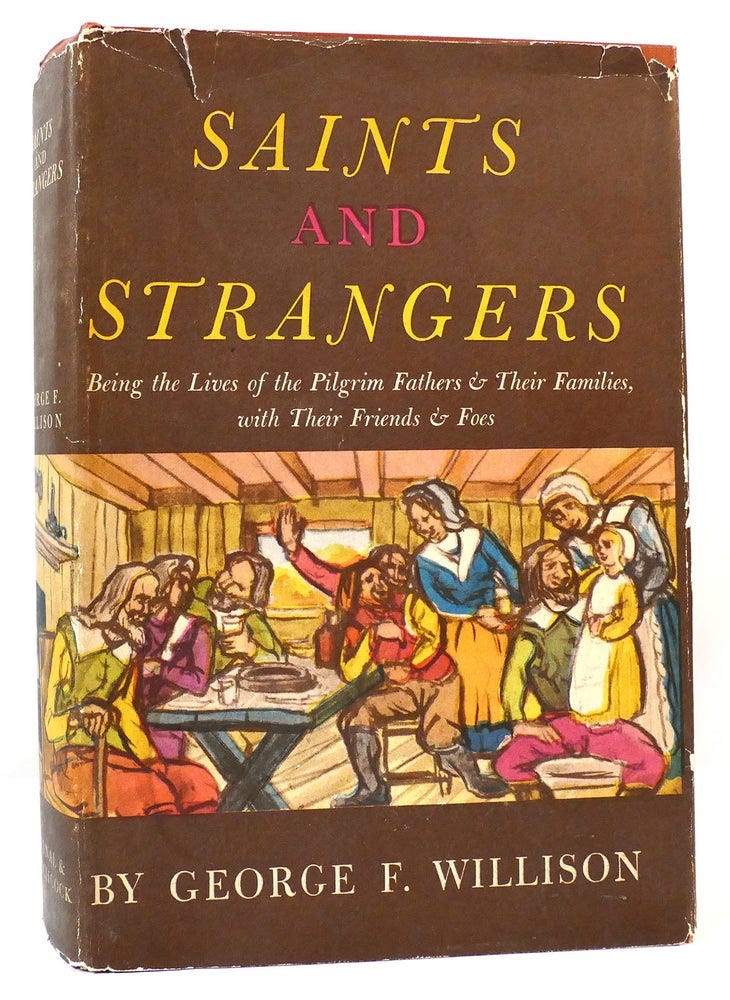
Last week I finished reading SAINTS AND STRANGERS by George Willison. It immediately became one of the top two books I’ve ever read about the Pilgrims, and I’ve read at least 17 books about the Pilgrims. (Behold the receipts)
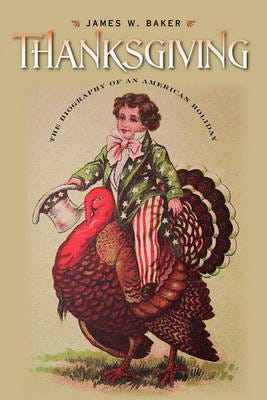
Anyway, now I’m finishing a book specifically about the history of Thanksgiving as a holiday, written by James W. Baker. He opens up with a summary of Pilgrim/Puritan “Holy Days,” trying to figure out which was the first official one that they observed, and it turns out that’s actually kind of tricky.
One of the key elements of the Puritans’ discord with other branches of the Church was their refusal to observe any holiday that wasn’t in Scripture (basically all of them.) They would, however, observe Fasts and Thanksgivings, depending on whether they needed to repent or show gratitude to God. (Often these sat opposite each other on the calendar, but again, this was the cause of some argument, because that would constitute a holiday, and boooooo.)
As Baker starts to list off days when the Pilgrims were known to observe fasts or feasts, he was able to nail down a particular event in 1623, which was one of the first decent harvests they had after arriving in 1620. (Even the 1621 feast was somewhat modest, and the harvest gains were wiped out about a month later when another ship pulled into harbor with 30 more mouths to feed.)
So while there’s evidence for a 1623 Fast and Thanksgiving, it’s hard to say those were definitely the first, because the Pilgrims were known to be in much greater need during previous years (and would have definitely attributed their suffering to the trying hand of a displeased God.)
It’s hard to know because we know that we don’t have complete records from the Pilgrims. The most significant firsthand account is OF PLYMOUTH PLANTATION, written by William Bradford in the 1640s, but the manuscript somehow ended up in the archives of an English university and wasn’t discovered until the 1800s, at which point it eventually made its way back to the States. With all the correspondence between Plymouth and England—and the turmoil of a civil war and interregnum in the mid-1600s—it’s no surprise that things got lost in the mail.
That manuscript wasn’t the first late discovery though. Willison writes that in the late 1700s, a grocer in Nova Scotia was using whatever paper he could find to wrap orders of pickles, cheeses, etc, having acquired papers from various lot sales or donations—and it just so happened that some of the papers were original writings of William Bradford, shuffled around until they ended up in the commerce house of a filthy unwashed Canadian.
When this was discovered—likely by a customer—someone hurried over to the grocer to purchase those papers from him, salvaging them from the trash bin of history, yet obviously they couldn’t save everything, and so priceless recordings of a pivotal moment in America’s earliest colonies are lost forever. (This would not be Canada’s final sin against us.)
Thus, it’s hard to know when exactly the Pilgrims might have established a cyclical holy day of fasting or feasting. Ergo we just mark it as the 1621 harvest feast, because we know that was the first, even if it wasn’t the last time they struggled in the New World.
My unofficial slogan of pro-literacy on Twitter has been “Read book, learn thing,” especially when someone comes in off the top rope with a completely stupid take that they might not hold if they could ever bother themselves to finish a piece of non-fiction.
Read book. Learn thing.
And among those things, learn this:
History is fickle at times, and you won’t always be able to learn everything.
But try anyway. And be thankful for what you find.
Go buy my novel FOSSIL FORCE.